



Ask three drivers where your hands should go on the steering wheel and you may get three answers. Many parents learned 10 and 2, many new drivers hear 9 and 3, and plenty of experienced drivers steer with one hand at the bottom of the wheel. That confusion matters, because hand position affects how quickly you can steer around a hazard and how an airbag affects your arms in a crash.
This guide explains the correct hand position on the steering wheel today, why the advice changed, how to steer through turns with push-pull and hand-over-hand methods, and what the Massachusetts road test expects from your hands.
Quick Summary
The safest hand position on the steering wheel is on the outside of the rim at about 9 and 3 o’clock, or slightly lower at 8 and 4. Federal safety guidance describes a normal range of 8 to 9 o’clock for the left hand and 3 to 4 o’clock for the right. Use push-pull steering for most turns so your hands never cross over the airbag.
- 9 and 3 is the modern standard: it keeps your arms out of the airbag’s path and gives balanced control.
- 10 and 2 is outdated in airbag cars: safety guidance says it can be dangerous in cars with smaller steering wheels and airbags.
- Push-pull steering keeps hands from crossing: one hand pushes up while the other slides and pulls down.
- Hand-over-hand still has a job: it is for sharp, low-speed turns, parking and recovering from a skid.
- One hand at 12 o’clock is for backing up: it lets you turn your body to look behind you.
- The road test notices posture: the Massachusetts Driver’s Manual asks applicants to keep both hands placed properly on the wheel.
| Situation | Hand position or method | Why |
|---|---|---|
| Normal driving | Both hands at 9 and 3, or 8 and 4 | Balanced control and arms clear of the airbag |
| Most turns and curves | Push-pull steering | Hands never cross the center of the wheel |
| Sharp, low-speed turns and parking | Hand-over-hand | Turns the wheel farther and faster |
| Recovering from a skid | Hand-over-hand, with quick, smooth inputs | Fast steering corrections |
| Backing up | One hand at 12 o’clock | Lets you turn and look through the rear window |
Want an instructor to check your steering habits before your road test? Contact CMSC Driving School to book a driving lesson.
What is in this guide
- Where should your hands be on the steering wheel?
- Is 10 and 2 still correct, or is 9 and 3 better?
- How do airbags change where you hold the wheel?
- How should you grip the steering wheel?
- What is push-pull steering and how do you do it?
- When should you use hand-over-hand steering?
- How do you steer when backing up?
- How do you steer if the car starts to skid?
- Is it OK to drive with one hand on the wheel?
- What does the Massachusetts road test expect from your hands?
- How can parents who learned 10 and 2 coach a teen driver?
- What if you drive with adaptive steering equipment?
Where should your hands be on the steering wheel?
Your hands should be on the outside of the steering wheel rim, with your left hand between 8 and 9 o’clock and your right hand between 3 and 4 o’clock. Picture the wheel as a clock face. At 9 and 3, your hands sit level with each other across the middle of the wheel, which gives you equal leverage to steer left or right.
Federal safety guidance describes this as a range rather than one exact spot, so 8 and 4 is also acceptable. Lower positions tend to be more comfortable on longer drives and keep your forearms further from the airbag. The key is that both hands are on the wheel, on the outside of the rim, and roughly opposite each other.

Is 10 and 2 still correct, or is 9 and 3 better?
For most modern cars, 9 and 3 is better than 10 and 2. Federal safety guidance warns that the 10 and 2 position can be dangerous in vehicles with smaller steering wheels and airbags. With your hands high on the wheel, your arms sit right in front of the airbag, which deploys out of the center of the wheel with great force.
The 10 and 2 position made sense when cars had large steering wheels and no power steering, because holding the wheel higher gave drivers more leverage. Power steering and smaller wheels removed that need, and airbags added a new risk. That is why driving instructors now teach 9 and 3.
Is 8 and 4 an acceptable hand position?
Yes, 8 and 4 is an acceptable hand position. It sits within the 8 to 9 and 3 to 4 o’clock range that safety guidance describes, and some drivers find it more relaxed on the highway. Avoid going lower than that, because steering from the bottom of the wheel reduces how far and how quickly you can turn in an emergency.
How do airbags change where you hold the wheel?
Airbags change hand position because the airbag inflates from the center of the steering wheel in a fraction of a second. If your hands are high on the wheel or crossed over the center, the airbag can throw your arms back toward your face. Keeping your hands at 9 and 3 or 8 and 4, and steering without crossing your arms, keeps them out of that path.
- Keep hands off the center pad, which is where the airbag cover sits.
- Do not steer with your arm across the wheel, such as reaching across to grab the far side.
- Sit at a safe distance. Adjust your seat so your back stays against the seat, your elbows keep a slight bend and you are not crowding the wheel.
- Aim the wheel at your chest, not your face, if your steering wheel tilts.
How should you grip the steering wheel?
Grip the steering wheel firmly but lightly, with your fingers wrapped around the outside of the rim and your thumbs resting along the rim rather than hooked inside it. A light, steady grip lets you feel the road through the wheel and steer smoothly, while a tight grip tires your arms and makes your steering jerky.
- Adjust your seat first, so your feet reach the pedals comfortably and your arms have a slight bend.
- Adjust the wheel’s tilt and reach if your car allows it, so you can see the gauges.
- Place both hands on the outside of the rim at 9 and 3 or 8 and 4.
- Rest your thumbs along the rim instead of wrapping them inside the spokes.
- Never steer by gripping the inside of the rim. Safety guidance warns against it, because your hand can get caught as the wheel turns.
- Relax your shoulders and keep your grip steady, not white-knuckled.
What is push-pull steering and how do you do it?
Push-pull steering, also called hand-to-hand or shuffle steering, is a method where one hand pushes the wheel up while the other hand slides up and then pulls it down, so your hands never cross over the center. Because both hands stay on the wheel and away from the airbag, it is the method widely taught for everyday turns.
- Start at 9 and 3.
- To turn left, push the wheel up with your right hand while your left hand slides up the rim.
- Pull down with your left hand while your right hand slides back down to its starting point.
- Repeat in small movements until the car is pointed where you want to go.
- To straighten out, reverse the motion with the same push and pull, feeding the wheel back through your hands.
Do not just let go and let the wheel spin back on its own after a turn. Feed it back with your hands so you stay in control of where the car goes.
When should you use hand-over-hand steering?
Use hand-over-hand steering for sharp turns at low speed, parking and recovering from a skid. In hand-over-hand steering, one hand reaches across the top of the wheel and pulls it down while the other hand lets go and grips again further along. It turns the wheel farther and faster than push-pull, which is why it suits tight spaces and quick skid corrections.
| Method | How it works | Best for | Watch out for |
|---|---|---|---|
| Push-pull | One hand pushes up, the other pulls down, hands never cross | Most turns, curves and lane changes | Slower for very sharp turns |
| Hand-over-hand | Hands cross over the top of the wheel | Low-speed sharp turns, parking, skid recovery | Arms cross the airbag area, so avoid it at speed |
| One hand at 12 o’clock | One hand steers from the top of the wheel | Backing up while turned to look behind | Only for reversing, not forward driving |
Practice both methods in an empty lot before you use them in traffic. Parallel parking and three-point turns are great practice for hand-over-hand. See our guides on how to parallel park step by step and how to do a 3-point turn in Massachusetts.
How do you steer when backing up?
When backing up, place your left hand at the 12 o’clock position on the wheel, turn your body to the right and look back through the rear window. Steer in the direction you want the back of the car to go. This one-handed position is the only time safety guidance suggests steering with one hand, because it lets you turn far enough to see behind you.
- Back up slowly, so small steering movements are easy to correct.
- Glance forward and to the sides often, because the front of the car swings the opposite way as you turn.
- Return to both hands as soon as you shift back into drive.
Our guide on how to back into a parking space walks through this step by step.
How do you steer if the car starts to skid?
If the car starts to skid, look and steer where you want the car to go, using quick, smooth hand-over-hand movements if you need to turn the wheel a lot. Avoid jerking the wheel or slamming the brakes. Skid recovery is one of the situations where safety guidance specifically lists hand-over-hand steering.
The best way to learn skid control is on a closed track, not on an icy road. CMSC’s SKIDZ School skid control program lets drivers practice steering, skid control and off-road recovery on one of only two skid tracks in Massachusetts. Read more in our article on skid school in Massachusetts.
Is it OK to drive with one hand on the wheel?
Driving with one hand on the wheel is not recommended, except briefly to use a control or shift gears, or when backing up. With one hand, you have less control if you hit a pothole, need to swerve or meet a sudden gust of wind on the highway. Resting an arm on the door or a hand on the shifter becomes a habit that is hard to break.
- Put both hands back on the wheel right after using a control.
- Set up the car before you drive, including mirrors, climate and navigation.
- Keep your phone out of reach. Massachusetts law restricts handheld phone use while driving, and our guide to the Massachusetts distracted driving law explains the rules.
What does the Massachusetts road test expect from your hands?
The Massachusetts Driver’s Manual tells road test applicants to use good driving posture with both hands always placed properly on the wheel. The examiner’s goal is to observe your driving performance, so smooth, controlled steering with both hands on the wheel shows you are ready to drive on your own.
- Keep both hands on the wheel at 9 and 3 or 8 and 4 throughout the test.
- Use push-pull steering for turns and feed the wheel back smoothly.
- Use one hand at 12 o’clock only when reversing, and turn to look behind you.
- Avoid resting an arm on the door or a hand on the shifter.
To prepare for the rest of the test, read our guides to the Massachusetts RMV road test and automatic fails on the Massachusetts driving test, or book road test preparation with CMSC.
How can parents who learned 10 and 2 coach a teen driver?
Parents who learned 10 and 2 can coach a teen driver by teaching the current 9 and 3 position and push-pull steering, even if they drive differently themselves. Teens copy what they see, so it helps for the supervising parent to model the same hand position during practice drives.
- Practice in an empty lot first, focusing only on steering and turning.
- Watch hand position in every turn and give calm, specific feedback.
- Align with what the instructor teaches, so your teen does not get mixed messages.
Our resources for parents of student drivers and tips for supervising a teen driver cover how to run productive practice sessions.
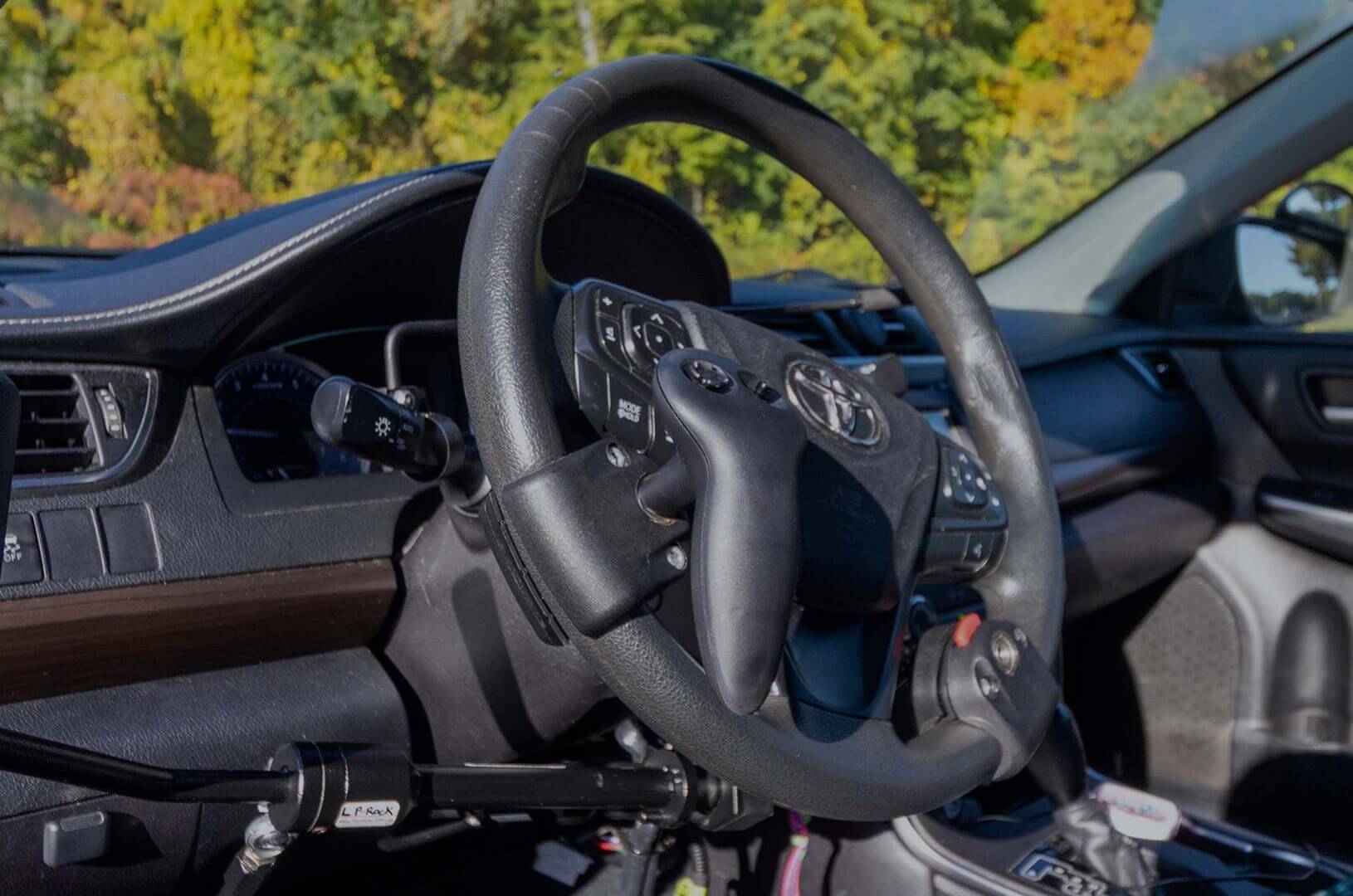
What if you drive with adaptive steering equipment?
If you drive with adaptive steering equipment, such as a steering aid or hand controls, your hand position and steering method will be set up around that equipment rather than the standard 9 and 3 position. The goal stays the same: smooth, controlled steering with the car fully in your command.
CMSC’s adaptive driving program gives drivers personalized instruction with adaptive equipment like hand controls, pedal extensions and steering aids, so they can build confidence and prepare for their license.
Why Massachusetts Drivers Choose CMSC
Good habits early. CMSC instructors coach hand position, push-pull steering and seat setup, so good habits are in place long before the road test.
Real experience. Central Mass Safety Council was founded in 1987 and has trained more than 100,000 students and adults, with more than 75 instructors across the state.
Skid control on a real track. CMSC’s West Boylston headquarters has one of only two skid tracks in Massachusetts, where drivers practice steering and skid control safely.
A program for every driver. Teen and adult drivers ed, road test preparation, advanced training and adaptive driving instruction are all under one roof.
