

Quick Summary
- Course: MSF Basic Rider Course (BRC): 5-hour online eCourse + two days of closed-range riding
- Road test: Waived for adults 18 and over who pass the skills evaluation
- Insurance: 10% motorcycle insurance discount from most Massachusetts carriers
- Permit required: Valid Massachusetts motorcycle learner’s permit before first range day
- What to bring: Permit, RMV endorsement fee prepaid, over-ankle boots, long trousers, long sleeves, full-finger gloves
- Motorcycle: Provided by CMSC. No personal bike needed.
- Licence timeline: Class M licence arrives within 10 to 14 business days after completion
- Location: CMSC West Boylston campus, Worcester County
- Pass rate: 85 to 90 percent on first attempt nationally
- Cost: $400 to $500 typical range, plus RMV permit and endorsement fees
Why Massachusetts Riders Need More Than a Permit Test
Most new riders underestimate what the permit test measures. The written knowledge exam at the RMV tests your understanding of traffic laws. It does not test your hands. The permit exam does not measure what you do when the rear wheel breaks loose on a wet road in Northborough. It does not prepare you for a car door opening into your lane on a Worcester commuter route. That gap is where riders get hurt.
According to the NHTSA, motorcyclists are 26 times more likely to die per vehicle mile than car occupants. They are also more than five times more likely to suffer serious injury. Those numbers do not respond to optimism. Specific skills drive improvement: emergency braking, hazard perception, and low-speed maneuvering. Building muscle memory to execute those skills under pressure is the goal of every MREP-approved course.
Why the MSF Basic Rider Course Is the Right Choice
Completing an MSF Basic Rider Course before riding on a public road addresses that gap directly. The RMV does not require it for most adults. Riders who complete it are genuinely better prepared for the conditions that cause crashes. That preparation is the entire point.
The BRC also carries two practical benefits beyond safety. First, it waives the RMV motorcycle road test entirely for adult riders. Second, completing it earns a 10% motorcycle insurance discount from most Massachusetts carriers. For many students, those savings offset a meaningful portion of the course cost within the first renewal period. For a complete breakdown of how the road test waiver works and which riders qualify, see the CMSC guide to the Class M Road Test Waiver in Massachusetts.
Before Your Motorcycle License Course Begins: What You Need to Know
Several requirements apply before your first riding session. Missing any of them can delay your license or prevent course completion from counting toward it.
The Learner’s Permit Requirement
You do not need a motorcycle learner’s permit to enroll in the course. You do need one before your first in-person riding session. Without a valid permit in hand, the course cannot count toward your Class M license under Massachusetts MREP rules.
Getting your permit involves three steps. First, pass the motorcycle written knowledge test through the online myRMV portal at home. The permit test is no longer taken in person at an RMV Service Center. Second, visit an RMV branch to complete the vision screening and submit identity documents. Third, pay the $30 permit fee. You can also prepay the motorcycle endorsement fee ($15, prorated based on your license renewal date) or the motorcycle-only license fee ($50 if you do not already hold a Class D license) at the same visit. Pre-paying the endorsement fee before your first class session is required by the Massachusetts RMV under the MREP framework. For a checklist of what to bring to your RMV permit appointment, see the CMSC guide to Massachusetts Permit Documents: The Complete RMV Checklist.
The Permit Expiry Rule That Catches Riders Off Guard
Your motorcycle learner’s permit must remain valid for at least three weeks beyond your course completion date. Students who let their permits expire close to the course date or schedule a course that finishes within three weeks of their permit expiry cannot have their completion processed by the RMV. If your permit is close to expiring, renew it before enrolling.
Permit Restrictions That Apply Immediately
Once your permit is issued, these riding restrictions apply on day one:
- You may only ride in Massachusetts on a Massachusetts permit
- Riding is permitted during daylight hours only
- You cannot carry passengers until you hold a full Class M license
- Off-road or trail riding is prohibited on a learner’s permit
The RMV lifts all restrictions the moment it issues your Class M license after course completion.
What to Bring and What to Wear
CMSC provides all training motorcycles and helmets. You do not need to bring your own bike or gear. However, specific clothing is required at every on-cycle session for your safety:
- Over-the-ankle footwear with a heel, such as boots or sturdy shoes
- Long pants without fraying or loose fabric at the cuffs
- Long sleeves or a jacket covering the full arm
- Full-finger gloves
Students who arrive without appropriate clothing cannot participate in range sessions. Plan your course-day outfit before enrollment, not the night before.
Inside the MSF Basic Rider Course: What CMSC Actually Teaches
CMSC runs the full BRC curriculum at its West Boylston campus in Worcester County. No prior riding experience is required. MREP designs the program for riders at all experience levels. The goal is to build safe, competent motorcycle operators through structured, supervised training.
Phase 1: MSF Online eCourse (5 Hours)
Students complete the 5-hour online module at their own pace before in-person sessions begin. The eCourse covers motorcycle controls, safety fundamentals, riding strategy, hazard perception, and defensive riding theory. Students must pass the online exam before attending the range. This phase builds the knowledge base the range work depends on.
Phase 2: On-Cycle Riding Sessions (Two Days)
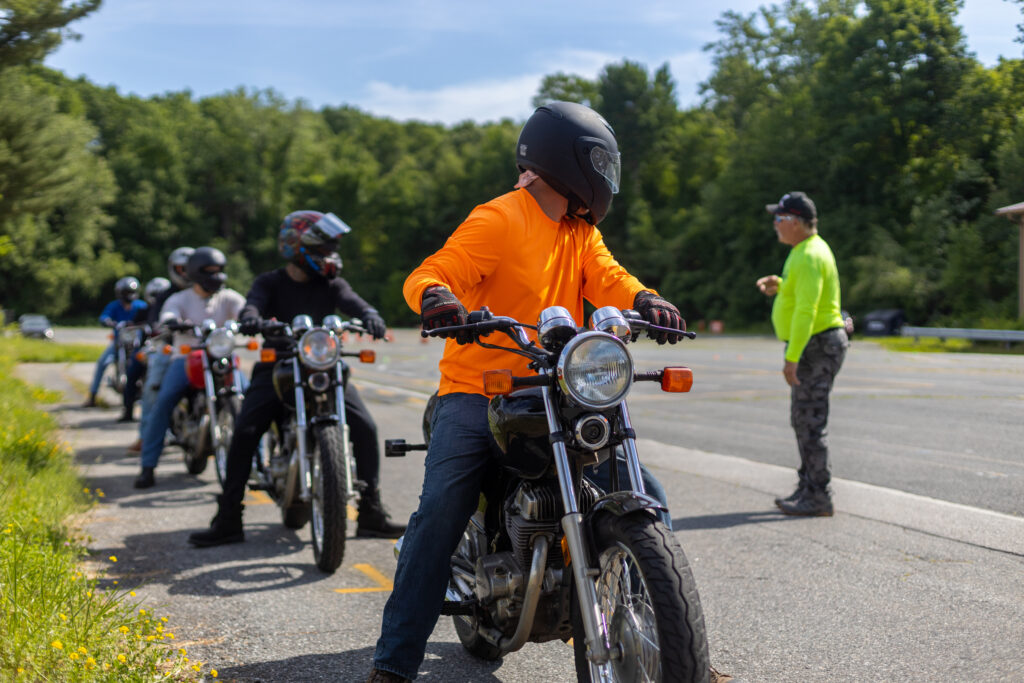
CMSC conducts all riding sessions on its closed training course. The curriculum builds riding competence in a deliberate sequence. No student advances until the current skill holds under supervision.
Skills covered on the range include:
- Motorcycle controls and pre-ride inspection procedure
- Clutch and throttle coordination at low speed
- Straight-line braking and controlled stops
- Turning, cornering, and countersteering technique
- Emergency braking from higher speeds
- Hazard avoidance and quick swerve techniques
- Riding skills evaluation for MSF completion card
CMSC provides all RMV-approved training motorcycles and helmets. Students cannot use personal bikes during the BRC. Licensed instructors supervise every on-cycle session. That close supervision separates genuine skill-building from basic exposure.
Who Qualifies for the Motorcycle License Course
Adults 18 and Over
Adult riders who complete the BRC and pass the skills evaluation skip the Class M road test entirely. The road test waiver removes two obstacles: scheduling an RMV road test appointment and passing the live evaluation. You move directly from course completion to license issuance.
Riders Under 18
Riders under 18 must complete the BRC as part of the Junior Operator License pathway. The road test waiver does not apply to riders under 18. Teen riders must meet all JOL requirements before the RMV issues a Class M license or motorcycle endorsement. For a full breakdown of Massachusetts junior operator restrictions and the teen licensing pathway, see the CMSC guide to Massachusetts Junior Operator Licence Curfew and Restrictions. Families with teens in the licensing process can speak with CMSC directly about the specific documentation and timeline requirements. CMSC’s teen driver’s education program handles the Class D licensing pathway, and the motorcycle program can be coordinated once JOL requirements are confirmed.
Experienced Riders: The BRC2 Option
Riders who already hold a Class M license and want to refresh or sharpen their skills have a second option. The Basic Rider Course 2 (BRC2) is designed for licensed riders who already have foundational skills. BRC2 sessions run at higher speeds, require riders to use their own motorcycles, and include five hours of on-cycle training rather than the full BRC curriculum. Completing the BRC2 also qualifies most Massachusetts carriers for a motorcycle insurance discount. Contact CMSC directly to confirm BRC2 availability and scheduling at the West Boylston campus.
How Much Does the Motorcycle License Course Cost in Massachusetts?
The Basic Rider Course at most MREP-approved schools in Massachusetts costs between $400 and $500. That fee typically includes the classroom component, all on-cycle range sessions, training motorcycles, and helmets. It does not include RMV permit fees or endorsement fees, which are paid separately and directly to the RMV.
In addition to the course fee, budget for the $30 permit fee and up to $50 for the motorcycle endorsement or motorcycle-only license fee, both paid to the RMV before your first class session. For many riders, a 10% motorcycle insurance discount earned by completing the BRC offsets a meaningful portion of those costs within the first one to two renewal periods. Contact CMSC’s motorcycle program directly for current pricing and scheduling at the West Boylston campus.
The Road Test Waiver and What Comes After
After passing the skills evaluation, CMSC submits your completion data directly to the RMV. Your Class M license arrives within 10 to 14 business days. Your MSF completion card is valid for 90 days from the date of issue. The RMV must process your license before that 90-day window closes. If you need to delay RMV processing, keep that timeline in mind before scheduling your course. Your MSF completion card also earns a 10% motorcycle insurance discount from most Massachusetts carriers. Most riders hold that discount for several years.
What Your Class M Licence Unlocks After the BRC
The moment the RMV processes your Class M license, every learner’s permit restriction lifts. Understanding what changes makes the difference between riding confidently and riding with lingering uncertainty about what you are and are not permitted to do.

Keep your MSF completion card in a safe place after the course. Insurers require it to apply the discount when you update your policy. If the RMV has not processed your licence within the 90-day validity window of the card, contact CMSC to confirm your completion was submitted correctly.
Your Odds of Passing the First Time
Between 85 and 90 percent of students pass the BRC skills evaluation on the first attempt nationally. Students who struggle typically lack foundational two-wheel balance before the range sessions begin. If you have never ridden a bicycle comfortably, spend time on one before your course date. That basic coordination makes a measurable difference once you are on the motorcycle.
CMSC’s Motorcycle License Course: Over 45,000 Riders Since 1976
Eleven MREP-approved motorcycle training schools operate across 25 locations in Massachusetts. Instruction quality, instructor backgrounds, and institutional depth separate them. CMSC has trained and licensed over 45,000 motorcycle riders since 1976. The school runs its motorcycle license course within the same institutional structure that has produced more than 100,000 licensed drivers in Central Massachusetts across four decades. Instructors must recognise where each student sits in their learning curve and adjust the next task accordingly. That calibration comes from experience. No curriculum manual teaches it.
The Instructor Difference at CMSC
CMSC’s instructor team includes professionals with backgrounds in law enforcement, commercial vehicle operation, and advanced rider training. Their composure creates a specific environment. Nervous students, which includes most new riders, do not absorb extra pressure from the instructor. Anxiety spreads quickly in a training setting. Its absence marks an experienced instructor.
That quality is not consistent across Massachusetts motorcycle schools. It shows in completion rates and rider confidence. CMSC also offers its motorcycle license course with Spanish-language instruction available. Riders who are more comfortable learning in Spanish should confirm availability when enrolling.
What the CMSC Training Environment Delivers
CMSC conducts all training on its dedicated closed course at West Boylston using RMV-approved motorcycles. Students arrive without a bike. They leave with the skills the course builds.

The curriculum sequences every skill deliberately. Foundational controls come before cornering. Low-speed work comes before emergency braking. No student advances until the current skill holds. Rushing that progression produces the incomplete skill set that crash statistics reflect year after year.
Beyond the motorcycle program, CMSC also offers the SKIDZ advanced driver training program for riders who want to build emergency vehicle control skills after earning their Class M license. The road test preparation service is available for Class D licensing. Riders who want to deepen their skills after earning the Class M license access that infrastructure within the same school without switching providers.
How to Enroll in the CMSC Motorcycle License Course
Enrolling in the CMSC motorcycle license course involves a few steps completed in order. Completing them in the wrong sequence, particularly paying the RMV endorsement fee after the course instead of before, is the most common administrative mistake that delays licence processing.
- Pass the RMV motorcycle written knowledge test through the online myRMV portal. Complete this at home before visiting any RMV branch.
- Visit an RMV Service Center with your identity and residency documents. Complete the vision screening and pay the $30 permit fee. Prepay the motorcycle endorsement fee at this visit, before your first class session.
- Book your course dates at the CMSC West Boylston campus. Confirm your permit does not expire within three weeks of your scheduled course completion date.
- Complete the 5-hour MSF online eCourse and pass the online exam before your first in-person range day.
- Attend both range days at the CMSC closed training course, wearing all required gear. CMSC provides the motorcycle and helmet.
- Pass the skills evaluation at the end of day two. CMSC submits your completion data to the RMV. Your Class M licence arrives within 10 to 14 business days.
To check available course dates and enrol at the West Boylston campus, visit the CMSC Motorcycle Program page. Riders who want more information about the beginner rider pathway before committing can also review the Motorcycle Riding Class for Beginners in Massachusetts guide.
What Students Say About the CMSC Motorcycle License Course
These are verified Google reviews from recent CMSC motorcycle program graduates. CMSC holds a 4.9-star rating across 3,379 verified reviews.
“I just completed the 2 day basic rider motorcycle course and it was great! Mike and Anish were very thorough with the lessons. It was done at a good pace. I highly recommend this CMSC course for anyone starting out as it lets you explore the required basic skills in a very safe and non-pressure environment. I plan to come back for more riding instruction here!”
Motorcycle BRC Graduate
“I took CMSC’s Basic Rider course having never ridden a motorcycle before. I was able to complete all of the tasks successfully and passed the driving test. The instructors were very patient and helpful. This course greatly boosted my confidence for riding a motorcycle and I highly recommend it to others interested in riding.”
Motorcycle BRC Graduate
“Mike was a fantastic instructor. I took the motorcycle course as a brand new rider, and he made me feel at ease! Well worth the cost, not to mention the insurance discount for taking the course.”
Motorcycle BRC Graduate
Conclusion
A motorcycle license course in Massachusetts through the MREP framework is the most complete route to a Class M license. The MSF Basic Rider Course delivers that framework. Completing the BRC waives your RMV road test for adult riders. It earns a 10% motorcycle insurance discount. It builds the on-cycle skills a permit test cannot measure. Massachusetts recorded 71 motorcycle fatalities in 2024. Structured training before public road riding is not optional. CMSC has delivered that training to over 45,000 riders from its West Boylston campus. Bring a valid permit that does not expire within three weeks of your course end date, pre-pay your endorsement fee, and arrive in appropriate gear. The CMSC motorcycle program takes care of everything else.