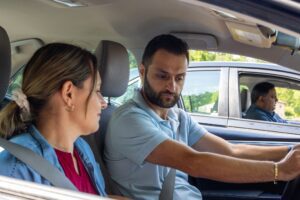


You have your learner’s permit, or you are an adult who never got around to driving, and you want a professional in the passenger seat instead of a nervous relative. Private driving lessons are the obvious answer, but most people are not sure what a lesson includes, whether Massachusetts requires them, or how to get the most out of each hour.
This guide explains how private driving lessons work in Massachusetts: who needs them by law, why the instructor must be licensed, what happens in your first lesson, what to bring, how home pickup works, and how private lessons get you ready for the RMV road test.
Quick Summary
Private driving lessons are one-on-one, behind-the-wheel sessions with a licensed instructor. In Massachusetts, drivers under 18 must complete driver education that includes at least 12 hours of behind-the-wheel instruction, while adults 18 and older are not required to take any lessons. For adults, private lessons are optional but often the fastest way to build safe habits and road test confidence.
- Teens have a legal minimum: driver education for applicants under 18 includes 30 classroom hours, 12 behind-the-wheel hours and 6 observation hours.
- Adults choose their own path: Massachusetts does not require driver education for applicants over 18, so lessons are a choice, not a rule.
- Instructors must be licensed: state law bars anyone from giving driving instruction for hire without a valid instructor’s certificate.
- You need a permit first: you must hold a valid learner’s permit to drive on public roads during lessons.
- Lessons and practice work together: teens also need 40 hours of supervised practice, or 30 hours after completing a driver skills development program.
- The school can supply the road test car: unless your test is scheduled through a driving school, you must bring your own vehicle to the RMV road test.
| Driver | Are lessons required? | What private lessons help with most |
|---|---|---|
| Teen under 18 | Yes, 12 behind-the-wheel hours inside driver education | Core car control, traffic rules and road test skills |
| Adult beginner 18+ | No | Building skills from zero with a calm, structured plan |
| Adult returning to driving | No | Refreshing habits and confidence after years away |
| Nervous or anxious driver | No (unless under 18) | Pacing practice so confidence grows step by step |
| Road test candidate | No | A final warm-up and a car and sponsor for test day |
Ready to book one-on-one time behind the wheel? Contact CMSC Driving School to schedule private driving lessons.
What is in this guide
- What are private driving lessons and who are they for?
- Do you need private driving lessons in Massachusetts?
- Do Massachusetts driving instructors have to be licensed?
- What happens in your first private driving lesson?
- What should you bring to a driving lesson?
- Can your instructor pick you up from home?
- Should you learn in the school’s car or your own?
- Private lessons vs practicing with a parent: which works better?
- Are there private driving lessons for nervous adult drivers?
- How many private driving lessons should you book?
- How do private lessons help you prepare for the road test?
What are private driving lessons and who are they for?
Private driving lessons are one-on-one sessions where a licensed instructor teaches you to drive on real roads. Unlike classroom driver education, the whole lesson focuses on you: your speed of learning, your weak spots and the routes and maneuvers you need to master. Private lessons are also called behind-the-wheel lessons or in-car driving lessons.
Private lessons suit almost every new or returning driver, but they matter most for people who do not have an experienced driver at home to practice with, or who feel anxious practicing with family.
- Teens in driver education who complete their required behind-the-wheel hours.
- Adults learning for the first time, including people who moved to Massachusetts without a license.
- Returning drivers who have not driven in years.
- Road test candidates who want a final check before test day.
- Drivers with specific worries, such as highways, parking or busy intersections.
Do you need private driving lessons in Massachusetts?
Whether you need private driving lessons in Massachusetts depends on your age. Drivers under 18 must complete a full driver education program before they can get a Junior Operator License, and that program includes behind-the-wheel time with a licensed school. Adults 18 and older are not required to take driver education or any set number of lessons.
What does Massachusetts require for drivers under 18?
Massachusetts driver education for applicants under 18 includes 30 hours of classroom instruction and 18 hours of in-car instruction, made up of at least 12 hours of behind-the-wheel driving and 6 hours of observing another student drive. A parent or guardian must also attend 2 hours of instruction. On top of that, teens need at least 40 hours of supervised driving, or 30 hours if they complete a driver skills development program, and they must hold their permit for at least 6 consecutive months before the road test.
See our guide to Massachusetts drivers ed requirements for the full breakdown, or explore teen drivers ed with CMSC.
Do adults 18 and older need driving lessons?
Adults 18 and older do not need to complete driver education in Massachusetts and have no required lesson hours. Even so, many adults choose private lessons because practicing alone is not an option on a permit, and a professional can fix habits before they become test failures. Our guide to getting a learner’s permit as an adult in Massachusetts covers the first step.
Do Massachusetts driving instructors have to be licensed?
Yes. Massachusetts law says no one may give driving instructions for hire without a valid instructor’s certificate, and driving schools must be licensed to operate. That means a paid “private instructor” who is not licensed through a Massachusetts driving school is breaking the law, and their lessons do not count toward driver education for teens.
- Ask whether the school is licensed by the Massachusetts RMV before you book.
- Ask about the instructor’s experience with your situation, such as teen drivers, adult beginners or nervous drivers.
- Confirm what counts toward requirements if you are under 18.
Our guide on how to choose a driving school in Massachusetts lists more questions to ask.
What happens in your first private driving lesson?
A first private driving lesson usually starts slowly. The instructor checks your permit, learns about any experience you have, and makes sure you are comfortable in the car before you drive anywhere busy. The goal is control and confidence, not covering as many roads as possible.
- Permit and paperwork check. The instructor confirms your learner’s permit before you drive.
- Getting to know the car. Seat, mirrors, steering wheel position, pedals, signals, wipers and lights.
- A quiet starting area. Many first lessons begin in a parking lot or a quiet street.
- Basic control. Smooth starts and stops, gentle steering, and holding a steady speed.
- Simple turns and observation. Signaling, checking mirrors and blind spots, and turning at low speed.
- Feedback and a plan. The instructor explains what went well and what to practice before the next lesson.
From there, lessons build toward busier roads, intersections, highway driving, parking and the maneuvers on the road test, such as the three-point turn and parallel parking.
What should you bring to a driving lesson?
Bring your valid learner’s permit to every driving lesson, because you cannot drive on public roads without it. A few simple preparations also make each hour more productive.
- Your learner’s permit, every single lesson.
- Glasses or contact lenses if your license or permit requires them.
- Comfortable, flat shoes that let you feel the pedals.
- Weather-ready layers, since you may step out of the car to check parking.
- A list of questions or situations that worry you, so the instructor can plan around them.
- Your phone switched to silent and put away while you drive.
Can your instructor pick you up from home?
Some driving schools offer pickup, so you do not need a ride to your lesson. CMSC offers adult beginner and refresher lessons at more than a hundred locations, including your home address, and runs adult morning lessons from its West Boylston location on weekdays.
Home pickup has a practical advantage: you can practice the roads you will actually drive every day, such as your commute or the route to school. Ask your instructor to include those roads once your basic control is solid.

Should you learn in the school’s car or your own?
Learning in the driving school’s car is usually best at the start, because the instructor knows the vehicle well and you are not risking the family car while you learn. Practicing in your own car later helps you get comfortable with the vehicle you will drive after you pass.
| Factor | Driving school car | Your own or family car |
|---|---|---|
| Best stage | First lessons and road test preparation | Supervised practice between lessons |
| Who supervises | A licensed instructor | A supervising driver 21 or older with at least 1 year of experience |
| Road test use | Can be used when the test is arranged through the school | Must pass the examiner’s vehicle check |
| Main benefit | Structured teaching and feedback | More hours and familiarity with your car |
If you plan to test in your own vehicle, read our guide to Massachusetts road test vehicle requirements first.
Private lessons vs practicing with a parent: which works better?
Private lessons and practice with a parent do different jobs, and most new drivers need both. An instructor teaches correct technique and spots mistakes early. Practice with a parent or another supervising driver gives you the repetition that turns those skills into habits.
- Use lessons to learn new skills, such as highway merging or parallel parking.
- Use supervised practice to repeat them on familiar roads.
- Keep the supervisor qualified. In Massachusetts, a supervising driver must be at least 21, have at least 1 year of driving experience and sit beside you.
- Track your hours. Teens need a parent or guardian to certify their supervised driving hours.
Parents can learn how to coach effectively in our tips for parents supervising a teen driver, and the RoadReady app guide shows one way to log supervised hours.
Are there private driving lessons for nervous adult drivers?
Yes. One-on-one lessons are well suited to nervous and anxious drivers, because the instructor can slow the pace, repeat a skill until it feels easy, and choose quieter routes before moving to busier traffic. You set the goals, and nothing happens until you are ready.
- Tell the instructor what worries you before the lesson starts.
- Start in low-traffic areas and build up gradually.
- Book lessons close together at first so progress is not lost between sessions.
- Celebrate small wins, such as a smooth left turn or a clean lane change.
Read more in our guides to lessons for nervous drivers in Massachusetts and returning to driving after years off the road.
How many private driving lessons should you book?
There is no single right number of private driving lessons. Teens must complete at least 12 behind-the-wheel hours inside driver education, but adults have no legal minimum, so the right number depends on your starting point, how often you practice between lessons and how quickly you build confidence.
- Start with a small block of lessons and review progress with your instructor.
- Practice between lessons with a qualified supervising driver whenever you can.
- Add focused lessons for the skills that still feel shaky, such as parking or highways.
- Finish with a road test warm-up close to your test date.
Adults can compare options in our guide to adult driving school classes in Massachusetts, or start with adult driving lessons at CMSC.
How do private lessons help you prepare for the road test?
Private lessons prepare you for the Massachusetts road test by letting an instructor rehearse the exact skills examiners watch, on roads similar to the test area. They also solve a practical problem: unless your road test is scheduled through a driving school, you must provide your own vehicle, and you need a qualified sponsor.
- Practice the maneuvers: three-point turns, parallel parking, backing and smooth stops.
- Work on observation: mirror checks, head checks and full stops at stop signs.
- Use a school car and sponsor: CMSC road test options include a CMSC vehicle, a sponsor and a Rules of the Road class, with group tests on Saturdays or an individual test at the RMV.
See CMSC road test options, and read about the most common automatic fails on the Massachusetts driving test so you know what to avoid.
Why Massachusetts Drivers Choose CMSC
Lessons that come to you. CMSC offers adult beginner and refresher lessons at more than a hundred locations, including your home address.
Decades of experience. Central Mass Safety Council was founded in 1987 and has trained more than 100,000 students and adults with more than 75 instructors.
Road test support. CMSC road test options include a CMSC vehicle and sponsor, so you can test in a car you already know.
More than basic lessons. From teen drivers ed to SKIDZ School skid control training, CMSC helps drivers keep learning after the basics.