


Getting a Massachusetts motorcycle permit is the first legal step toward a Class M licence, and it is where most new riders get stuck. The state publishes the rules across several pages, and some of the most repeated advice online is simply wrong. This guide puts the whole thing in one place, with the rules stated plainly and the myths cleared up.
Quick Summary
A Massachusetts motorcycle permit, formally the Class M learner’s permit, lets you practise riding on public roads before you qualify for a full Class M licence. It is issued after you pass a 25 question RMV knowledge test, and it is valid for two years. You may only ride between sunrise and sunset, and you may never carry a passenger.
- Who can apply: Massachusetts residents aged 16 or over who hold no licence or permit in another state.
- The test: 25 questions in 25 minutes, 18 correct to pass. You can sit it online or at a Service Center.
- Restrictions: daylight only, sunrise to sunset, and no passengers at any time.
- Highway riding: no Massachusetts rule bans a Class M permit holder from highways, despite what rider forums repeat.
- Validity: two years, with no renewal. If it expires you reapply and retake the exam.
- Next step: pass an RMV road test, or complete an approved rider course and skip the road test if you are 18 or over.
Not sure which route suits you? Central Mass Safety Council runs RMV-approved rider training in West Boylston, and the course route lets most adult riders skip the RMV road test entirely. See the motorcycle training programme.
What is a Massachusetts motorcycle permit?
A Massachusetts motorcycle permit is a Class M learner’s permit issued by the Registry of Motor Vehicles. It allows supervised practice on public roads while you work toward a full motorcycle licence. The RMV treats it as the entry point to every motorcycle credential in the state.
To qualify, the RMV requires you to be at least 16, be a Massachusetts resident, hold no driver’s licence or learner’s permit in any other state, be clear of outstanding obligations to any state, and meet the Class M medical standards. You also pass a vision screening for field vision and basic colours at your in-person appointment.
Is a motorcycle endorsement the same as a Class M licence?
They are two different credentials, and mixing them up is the most common confusion among Massachusetts riders. A Class M licence is a standalone motorcycle licence. A motorcycle endorsement is the letter M added to a driver’s licence you already hold, which produces a Class DM licence.
Both routes start with the same Class M learner’s permit. Which one you end up with depends on whether you already hold a Massachusetts driver’s licence when you qualify.
Do you need a motorcycle permit if you already have a Class D licence?
Yes. A car licence does not let you ride a motorcycle in Massachusetts. Everyone goes through the Class M permit first, whatever licence they already hold. The difference for Class D holders is what happens at the end: you add an endorsement to your existing licence rather than being issued a separate one.
How do you get a motorcycle permit in Massachusetts?
You apply to the RMV, pass a 25 question knowledge test and a vision screening. The RMV lets you sit the knowledge test online or at a Service Center, but the vision screening happens at an in-person appointment.
The sequence most Massachusetts riders follow:
- Study the Motorcycle Manual. The RMV names it as the study material for the exam. It is a free download from the state site.
- Start the application. Complete the Class D, M, or D/M licence and ID card application. Applicants under 18 need a parent or guardian to sign it.
- Book a Service Center appointment. Riders consistently report this as the slowest part of the process, so book it early rather than waiting until you are ready to test.
- Take the knowledge test. Online or in person, 25 questions in 25 minutes.
- Pass the vision screening. The RMV checks field vision and basic colour recognition at the Service Center.
Can you take your motorcycle permit test online in Massachusetts?
Yes. The RMV offers the Class M knowledge test online as well as at a Service Center. The online option has conditions: a working camera, a supported browser such as Google Chrome version 97 or later, a quiet room, no smartphone or tablet in reach, and nobody else in the room, including pets.
The RMV also provides alternative formats. Extended-time and paper exams can be requested at a Service Center for cognitive or physical disabilities. Person-to-person oral exams are arranged by phone on 857-368-8105 with written documentation.
What documents do you need?
Bring proof of identity and Massachusetts residency, and your completed application. Applicants under 18 need written parental consent from a parent, legal guardian, the Department of Children and Families, or a boarding school headmaster, given by signing the application. If the person consenting is not a parent, the RMV requires proof of their authority at the written test.
What is on the Massachusetts motorcycle permit test?
The exam is 25 questions in 25 minutes, and you need 18 correct to pass. The RMV lists the topics as rules of the road, the consequences of operating under the influence of drugs and alcohol, the Junior Operator Law, sharing the road with visually impaired people, and sharing the road with bicyclists and pedestrians.
What is the passing score on the Massachusetts motorcycle permit test?
You need 18 correct answers out of 25, which means you can miss 7 and still pass. The time limit is 25 minutes. Those are the figures the RMV applies to the Class M knowledge test, and they are the ones to study against.
What do most riders get wrong on the permit test?
Massachusetts riders consistently report two surprises. The first is how much of the exam is not motorcycle specific: roughly half the questions cover the same ground as the Class D car permit test. The second is the weight given to impaired riding, including word problems that ask you to work out whether someone of a given weight could ride home after a set number of drinks in a set time.
Junior Operator Law questions also appear for every applicant, not only for under-18s. Riders in their thirties and forties report being puzzled by questions about rules for 17 year old drivers. That is by design, so study that section even if it does not apply to you.
- Do not skip the Class D material. General road rules carry a large share of the questions.
- Learn the impaired riding content properly. It is the most commonly reported reason for a first-attempt failure.
- Read the Junior Operator Law section. It is examinable at any age.
- Study from the official Motorcycle Manual. The RMV names it as the study material for this exam.
If you want a sense of how Massachusetts knowledge tests are structured generally, our guide to how many questions are on the permit test covers the Class D version of the same exam format.
What do riders get wrong about the Massachusetts motorcycle permit?
Massachusetts rider discussions repeat a small set of beliefs that do not match what the state actually publishes. These are the ones that waste the most time, and in some cases a whole riding season.
State positions drawn from RMV pages, the Massachusetts Motorcycle Manual and the Massachusetts General Laws.
What are the Massachusetts motorcycle permit restrictions?
A Class M permit carries two restrictions in Massachusetts: you may only ride between sunrise and sunset, and you may not carry a passenger. Both appear in the Motorcycle Manual and in the state’s Junior Operator requirements. The permit application page itself does not list them, which is why so many riders never find them.

Can you ride a motorcycle at night on a permit in Massachusetts?
No. The rule is sunrise to sunset, not a fixed clock time. Riders often repeat it as something like “6:30pm to 6:30am”, which is wrong and gets people caught out. Sunset in Massachusetts moves by more than three hours between June and December, so the window you can legally ride in changes week by week.
Plan around actual sunset times rather than a remembered hour. In late autumn that can mean your riding window closes before you finish work.
Can you carry a passenger on a motorcycle permit?
No. The state is explicit that a Class M permit holder may not carry passengers while operating a motorcycle. There is no exception for a licensed rider sitting behind you, and no supervising-rider arrangement of the kind that exists for car permits.
Can you ride on the highway with a motorcycle permit in Massachusetts?
There is no highway or limited-access road restriction for Class M permit holders in any Massachusetts state rule we could find. This is one of the most confidently repeated myths in rider forums, usually stated alongside the real daylight and passenger rules, which gives it false credibility.
The confusion has two sources. Junior Operator Law rules restrict under-18 drivers in ways that riders generalise to all permit holders. Separately, the Motorcycle Manual does set limited-access rules, but those apply to mopeds and limited-use vehicles, not to a Class M permit. Treat a highway ban as unproven unless the RMV states it on your own permit.
Can you register a motorcycle with just a permit?
Registration and licensing are handled separately by the RMV, so holding a permit rather than a licence is not in itself what blocks a registration. The real problem riders hit is a timing one: a credential passed online may not appear on the myRMV account straight away, and the registration counter works from what is on the account.
Riders describe passing the online test, seeing their class change on myRMV, then being turned away at registration with no printable proof and a month-long wait for the next appointment. Confirm the credential is visible on your account before you plan a registration visit.
How long is a Massachusetts motorcycle permit good for?
A Massachusetts motorcycle permit is valid for two years, or for the length of your authorised stay in the United States if that is shorter. The RMV applies the same two year term to Class A, B, C, D and M permits alike.
What happens if your motorcycle permit expires?
You reapply and retake the exam. The RMV states there is no renewal process for an expired permit, so the application and the 25 question test both come round again. This catches out riders who assume a permit works like a licence.
It also creates a real trap. Riders who cannot get a road test appointment within travelling distance sometimes let the clock run down while they wait. One Massachusetts rider described logging in at midnight when new slots released and finding them already gone, with a permit due to expire in a few months. If your permit is heading toward expiry and you have no booked test, the course route is usually the faster way out.
Do you need a permit before taking a motorcycle safety course?
This is the single most asked question among Massachusetts riders, and the state does not answer it. The RMV’s Massachusetts Rider Education Program page sets out what the courses are and which ones waive the road test, but it does not say whether you must hold a permit to enrol. That is left to each school.
The result is that riders are told opposite things in the same conversation. Some schools require the permit before you book. Others do not. Central Mass Safety Council states on its motorcycle programme page that no motorcycle learner’s permit is required to start, with students visiting the RMV after the course to pass the permit knowledge test and complete the vision screening.
Before you book anything, ask your school two questions:
- Do I need a valid Class M permit on the day the course starts, or can I get it afterwards?
- Does the school supply the motorcycle, or do I need to bring my own?
Those two answers decide your whole sequence. Getting them wrong is how riders end up with a booked course and an RMV appointment that falls after it.
The bike question has no single answer either. The RMV states that the Basic RiderCourse 2 requires you to be on your own motorcycle, while the beginner Basic RiderCourse normally supplies one.
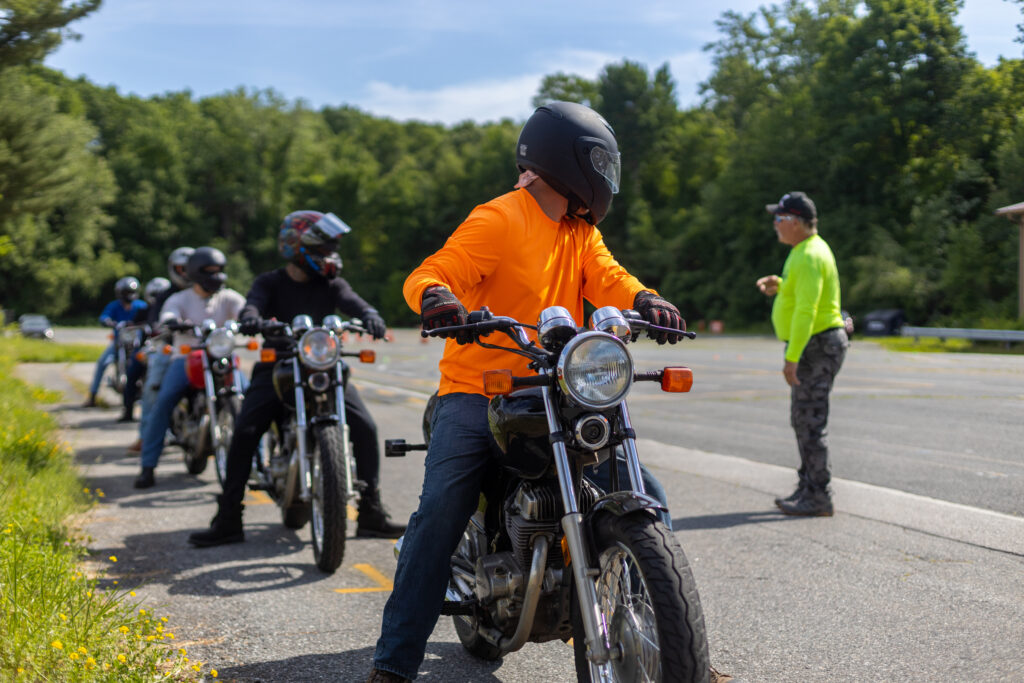
At Central Mass Safety Council, students are not permitted to use their own motorcycle. All training is conducted on RMV-approved CMSC motorcycles, with a helmet provided if needed. You can read what the course involves in our guide to the motorcycle license course in Massachusetts.
What comes after the permit: road test or rider course?
Once you hold the permit you have two ways to reach a Class M licence. You can book an RMV road test, or you can complete an approved rider course and have the road test waived. The RMV names three courses that carry the waiver: the Basic RiderCourse, the Basic RiderCourse 2, and the 3 Wheel Rider Course.
What does the Class M road test involve?
The RMV describes a pre-test check of your knowledge of motorcycle equipment and controls, then figure eights and 360 degree circles in both directions without your feet touching the road, normal starts and stops, riding in traffic, crossing intersections and making turns.
Your motorcycle must be safe and in good working order, carry a valid registration document and a valid inspection sticker. The examiner cancels the test if they judge the machine unsafe. If the motorcycle is registered out of state, you must show the examiner proof of insurance at Massachusetts minimum limits.
Two details are worth knowing before you book. Testing on a limited-use vehicle or a three wheeled trike produces a Class M licence carrying a U restriction, which limits you to that vehicle type. And the RMV states you do not need a sponsor for a Class M road test, unlike the Class D test. Our guide to the Massachusetts RMV road test covers how test bookings work generally.

What happens if you fail the Class M road test twice?
You must enrol in and complete the RMV-approved beginner rider course before you can test again. This is a state rule, not a school policy. Riders who assume they can simply rebook after a second failure find the course is now compulsory.
The road test booking is also forfeited if you fail, turn up unprepared, arrive without a registered vehicle, are late, do not appear, or cancel or reschedule with less than 72 hours notice. Tests the RMV cancels for weather are rescheduled without penalty.
Who does the road test waiver not cover?
Riders under 18. The RMV states that you do not have to take a Class M road test if you have completed the approved beginner rider course, unless you are under 18 years of age. Junior operators complete the course in addition to the road test and the rest of the junior operator requirements.
This exception is easy to miss, because the waiver is usually described without the age condition attached. A 17 year old planning around the waiver alone will be wrong. Our Class M road test waiver guide explains how the waiver works for adult riders.
What are the permit rules for riders under 18 in Massachusetts?
Under-18 riders follow the Junior Operator Law pathway, which is considerably longer than the adult route. The minimum age for the permit is still 16, and the minimum age to apply for the licence is 16 and a half.
Alongside the motorcycle requirements, the state requires driver’s education of all Class D and Class M applicants under 18: 30 hours of classroom instruction, 12 hours behind the wheel, 6 hours of observation, 40 hours of supervised driving certified by a parent or guardian, and 2 hours of parent or guardian instruction. The supervised driving requirement drops to 30 hours if a driver skills development programme is completed.
Under-18 applicants must also hold a valid learner’s permit for at least 6 consecutive months and keep a clean driving record for at least 6 consecutive months before the road test. A suspension invalidates the permit and restarts the six months.
A permit holder under 18 also may not drive between midnight and 5am unless accompanied by a licensed parent or legal guardian with at least one year of driving experience whose licence is not suspended or revoked. Our Massachusetts JOL restrictions guide sets out the full junior operator rules.
Moving to Massachusetts with an out-of-state permit or endorsement
If you hold a licence from another state, the RMV requires you to convert it when you become a resident. An active out-of-state licence, or one expired less than a year, needs no written or road test. A licence expired more than a year means a full written test, road test and eye test.
The transfer cannot be completed online. You start the application online to get a document checklist, then attend a Service Center with a reservation. The new licence arrives by post in 10 to 14 days.
If you completed a rider course in another state, that is a separate process. The RMV recognises most approved and certified motorcycle rider education programmes in other states, and asks you to submit the paperwork within 180 days of the training. You need a valid Massachusetts motorcycle permit, your out-of-state Motorcycle Safety Foundation completion card, and your skill evaluation and knowledge test results on the school’s letterhead.
One practical warning from riders who have done this: check the endorsement actually transferred before you leave the counter. Several Massachusetts riders report their motorcycle endorsement being quietly dropped during a licence transfer and only noticing later.
When should you start, and when do courses fill up?
Massachusetts riding is seasonal, and so is course availability. The RMV times its own rider safety campaign to late March, noting that spring marks the return of many riders to the road and is one of the highest risk periods of the year.
Riders report the practical consequences. Asking in late April, one found advanced courses already full into August. Asking in late September, another found a single remaining course date left for the entire year. Seats are scarcest exactly when demand peaks in spring.
- Book February or March if you want a spring seat and a choice of dates.
- Get the permit appointment early, because Service Center slots move slower than course seats.
- Consider a weekday session. Riders describe weekday classes as far smaller than packed weekend ones, which matters if you have never sat on a motorcycle.
- Expect to ride in whatever weather arrives. Courses run rain or shine, and Massachusetts riders describe completing evaluations in heavy rain and thunderstorms.
Central Mass Safety Council has trained and licensed over 45,000 motorcycle riders since 1976, with training on RMV-approved motorcycles at the West Boylston track. See what the beginner class covers or get in touch to check the next available dates.
What do you need to wear on a permit and at a course?
Massachusetts law requires a helmet. Chapter 90, section 7 of the General Laws requires every person operating a motorcycle, and every passenger, to wear approved protective head gear. The Motorcycle Manual states the helmet must comply with the federal DOT standard FMVSS 218.
The same section requires eye protection when the motorcycle has no windshield or screen: glasses, goggles or a protective face shield. Jackets, trousers, over-the-ankle boots and gloves are recommended by the manual rather than required by law.
Schools set their own minimums for course days, which are usually stricter than the law. Massachusetts riders who have taken the course describe the practical list as long trousers, a long-sleeved top or jacket, over-the-ankle boots, gloves and eye protection, and note that ordinary hiking boots and work gloves are accepted. Our guide on what to wear to a motorcycle course in Massachusetts covers the detail.
Your next step
If you are starting from nothing, the order that works for most adult riders in Massachusetts is simple: book your rider course first, because seats are the scarcest part, then sort the permit appointment around it. Confirm with the school whether they need the permit on day one before you commit to that order.
If you already have the permit and the clock is running, compare the two routes honestly. The road test needs a registered, inspected motorcycle you can get to the test site. The course does not, and for riders aged 18 and over it removes the road test altogether.
Central Mass Safety Council runs RMV-approved rider training on the West Boylston track with motorcycles provided. View the motorcycle training programme and dates, or read our full guide to the motorcycle license course to see what the two days involve.
How we created this guide
Every rule on this page was taken from Massachusetts state sources: the RMV’s Class M permit and road test pages, the Massachusetts Rider Education Program page, the Junior Operator requirements, the Massachusetts Motorcycle Manual, and Massachusetts General Laws chapter 90, sections 7 and 8B.
Course details and training policies attributed to Central Mass Safety Council come from our own programme pages. The rider experiences described, such as appointment availability, course capacity and what surprises people on the exam, come from public Massachusetts rider discussions reviewed during research, and are presented as rider reports rather than state rules.
Where the state does not publish an answer, we say so instead of filling the gap. That applies to whether a permit is required before enrolling on a course, and to any highway restriction on a Class M permit. This guide was researched and drafted with AI assistance, then fact checked against the state sources listed above by a person before publishing.
About the Author

